Why IT backlogs kill innovation and how domain experts can take the lead
Great AI ideas rarely die from lack of merit. They die in the backlog.
A sales leader sees exactly how AI could qualify leads faster. A service manager knows a diagnostic guide could cut resolution times in half. The vision is clear. The value is obvious. But to make it real, they have to file a ticket with IT and wait. Weeks pass. Priorities shift. By the time something comes back, it no longer fits the need. The moment has moved on. This isn't just a technology problem. It's a cultural bottleneck. One that sends a clear message to the people closest to the work: "Your ideas are valid, but you're not allowed to build them."
The result? Innovation stalls. Expertise stays locked in people's heads. AI adoption becomes a slow, frustrating process driven by gatekeepers rather than practitioners. There's a better way.
The traditional path from AI idea to working application follows a familiar pattern
A frustrating one.
It starts when a business user spots a workflow problem or opportunity. They submit a request to IT or a central AI team. That request enters a queue alongside dozens of competing priorities. Months later, if the project survives at all, a solution arrives. Too often, it misses the mark. The original context has shifted. The nuances were never fully understood. The people who needed it have already moved on.
This cycle creates three compounding problems:
- Speed mismatch. Business needs evolve faster than IT can respond. By the time a solution is ready, the problem has changed shape.
- Context loss. The people who truly understand the workflow aren't the ones building the solution. Critical details get lost in translation.
- Adoption friction. When tools are handed down rather than built up, teams are less likely to embrace them. Ownership never transfers.
- For organizations trying to scale AI, this isn't a minor inconvenience. It's a structural barrier. One that quietly kills innovation before it has a chance to prove itself.
Practical Outcomes Through Expert-Led Building
What changes when domain experts can build their own AI applications without writing code or waiting for IT? Three practical shifts happen almost immediately.
Faster iteration cycles:
Instead of waiting months for a prototype, experts can build, test, and refine in hours. A sales enablement lead uploads product documentation, configures an AI assistant, and sees how it performs in real conversations. All before the day ends. What once took quarters now takes moments.
Closer alignment to real workflows:
The people who live the work every day understand its texture. A service technician knows which diagnostic steps get skipped most often. A compliance officer knows which policy questions surface again and again. When these experts build their own tools, the result reflects operational reality. Not an abstracted version of it.
Immediate feedback loops:
Expert-built applications can be tested in context, adjusted on the spot, and improved continuously. The long feedback cycles that plague traditional IT projects disappear. Problems get solved while they're still fresh. The practical outcome is clear. AI applications that are faster to build, more relevant to the work, and easier to improve over time.
Cultural Empowerment and Organizational Momentum
Beyond the practical gains, something deeper shifts when domain experts build their own AI applications.
From consumers to creators:
When employees realize they can shape AI, not just use it, their relationship with the technology transforms. They move from passive adoption to active ownership. This matters more than it might seem. Adoption is often the hardest part of any AI initiative. But when people build something themselves, they use it. They improve it. They advocate for it. Ownership isn't assigned. It's earned through creation.
From isolated projects to organizational momentum:
Success travels. When one team builds a working AI application, others take notice. A sales team's lead qualification assistant becomes a template for customer success. A service team's diagnostic guide inspires HR to build an onboarding mentor. Each win sparks the next. Instead of isolated pilots that never scale, organizations build a continuous cycle of innovation. Driven by the people closest to the work.
From fear to familiarity:
Many employees approach AI with uncertainty. Will it replace me? Will I know how to use it? When experts build their own AI tools, they demystify the technology through direct experience. They learn by doing. Fear gives way to fluency. Fluency builds confidence.
The Real Question: What’s Stopping You?
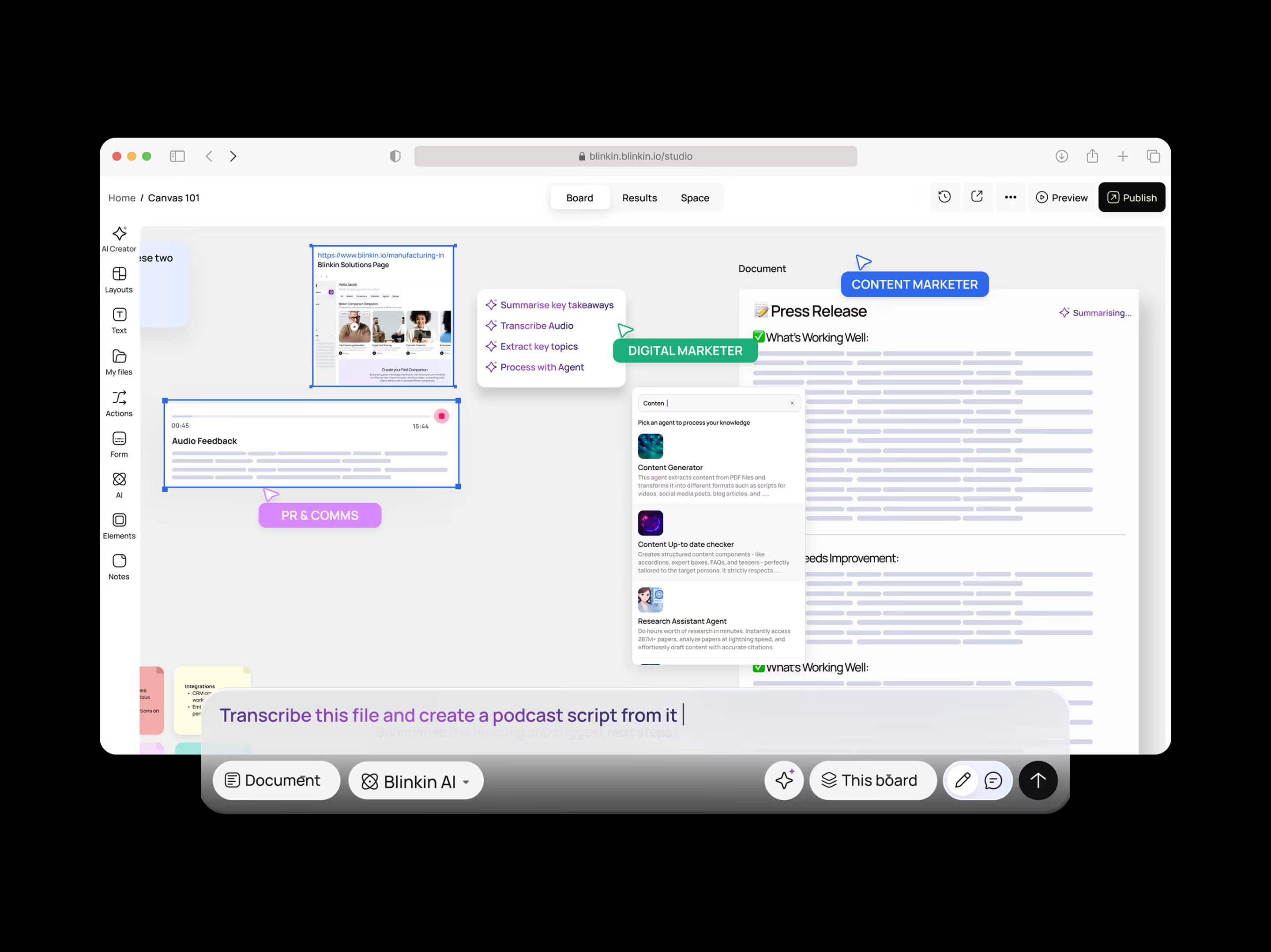
Blinkin's no-code studio puts multimodal, logic-driven AI application building in the hands of the people who know the work best.Domain experts can upload their manuals, videos, and notes and turn that knowledge into interactive AI applications. No code. No waiting for IT. No ideas lost in the backlog.If your organization is ready to move AI innovation out of the queue and into the hands of your experts, explore how Blinkin can help.
Learn more about Blinkin's no-code AI studio.
Key Takeaways
- IT backlogs are innovation bottlenecks. When every AI idea must pass through a central queue, most ideas never survive the wait.
- Domain experts are the best builders of workflow-specific AI. They understand the context, the nuances, and the real problems worth solving.
- No-code platforms unlock practical outcomes. Faster iteration, tighter alignment to workflows, and immediate feedback loops.
- Expert-led building drives cultural change. Employees shift from AI consumers to AI creators. Adoption follows naturally.
- Success compounds. Each expert-built application inspires the next, creating momentum that spreads across the organization.
- Adoption is built in from the start. When people build their own tools, they use them.